Flags
When we talk about flags in assembly, we are referring to a register that contains a variety of bits representing state and status information. This register may vary in size - many portions (in newer processors) are not used.
| FLAG | Size |
|---|---|
| FLAGS | 16 bits |
| EFLAGS | 32 bits |
| RFLAGS | 64 bits |
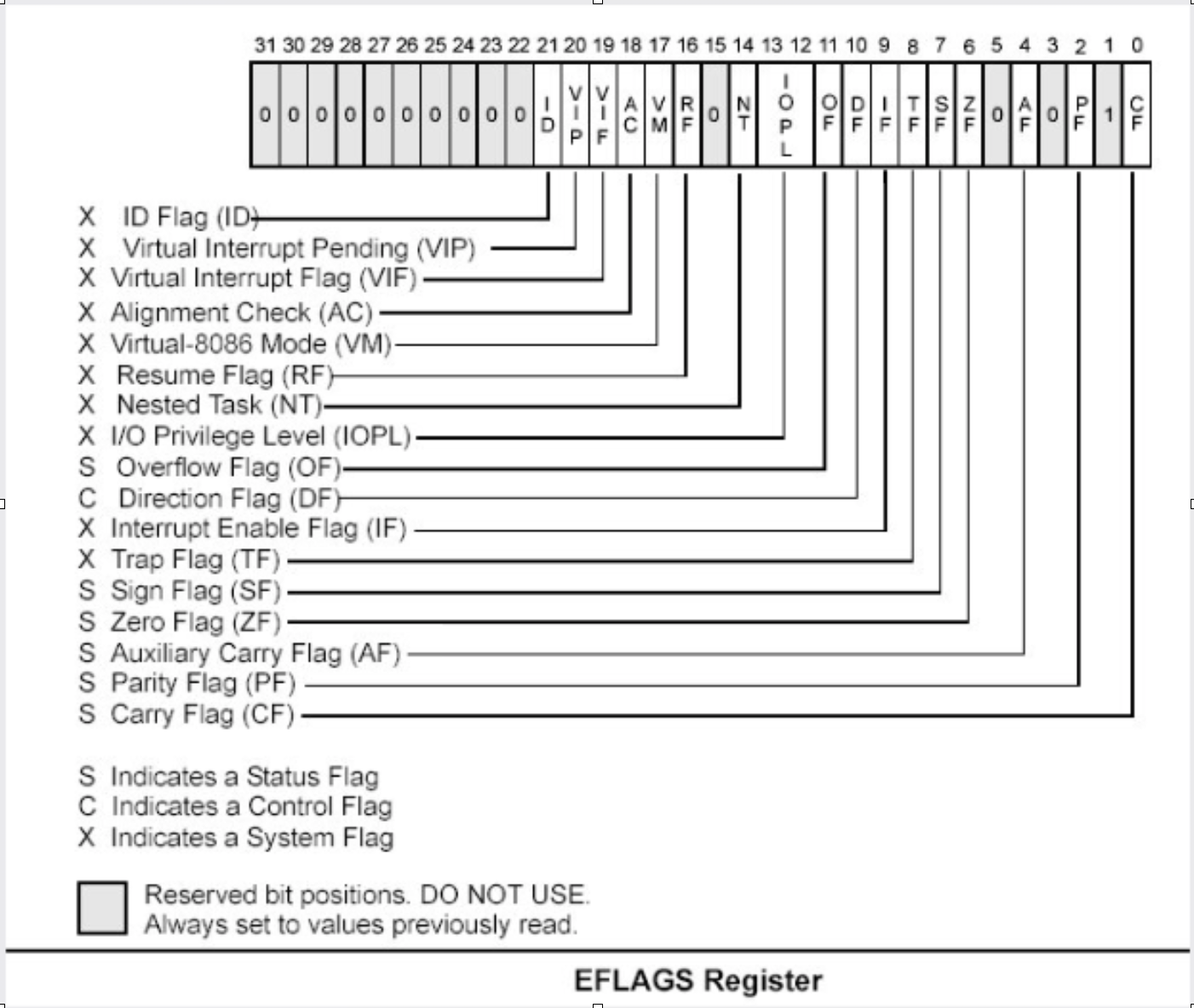
Flags We Care About Now
Zero Flag (ZF)
- Set when arithmetic or bitshift operations produce a zero
- In other words, this flag gets set if an arithmetic result is zero
Carry Flag (CF)
- Set when an arithmetic borrow or carry occurs during
add/sub- e.g. the result of anaddwould have set bit 33 (in x86), or bit 65 (in x86_64)- Also set with some bitshift operations (such as when a bit falls of the end in a
shr/shl) - This is for unsigned numbers
- Can happen when two unsigned numbers were added and the result is larger than the "capacity" of register where it is saved
- Ex: We add two 8 bit numbers and the saved result is larger than the 8 bit register we store it in
- Also set when two unsigned numbers were subtracted and we subtract the larger one from the smaller one
- Also set with some bitshift operations (such as when a bit falls of the end in a
Overflow Flag (OF)
- Indicates that sign bit of the result of an operation is different than the sign bits of the operands
- Ex: Adding two large positive numbers ends up producing a negative result (due to overflow)
- Ex: If we subtract two numbers that are smaller than register size (-129 for 8bit)
- This applies to signed numbers
Sign Flag (SF)
- Set to indicate the result of an operation is negative
Accessing the Flags
- Can be set and checked manually
- Some have special instructions for set and clear (which we'll talk about later)
- Flag register can be accessed and set manually via
pushf(d|q)/popf(d|q) - Refer to below (
pushfpopf)
pushf and popf
-
Description
- Pushes the flag register (or the first 16 bits... eflags(32 bits) or rflags(64 bits) (if
pushfdorpushfq) onto the stack, and pops the value on top of the stack into the flags register (or eflags/rflags) - Higher 32 bits in rflags are reserved
- Thus we can just handle rflags as eflags - there is no difference
- In reality, the flags we will be accessing are within the first 16 bits
- Pushes the flag register (or the first 16 bits... eflags(32 bits) or rflags(64 bits) (if
-
Basic Use
pushf       ; flags have been pushed to the stack
; ... do stuff
popf        ; flags have been restored
-
How does this really work?
- First you specify how many of the flags you want to push onto the stack (pushf)
- From there, you can pop those back off into a register (
pop reg, raxfor example) - From there you can modify the value in that register
- From there you can push that register back onto the stack (
pushf) - Finally you can pop the flag off, taking the new value with it. (
popf)
Complete Performance Lab 6